Saturday, 29 October 2016

The Dreaded Chair Seat

Hey guys! Long time no blog, so I thought I'd pull together a short post on what I and a lot of other riders struggle with - the dreaded chair seat. 
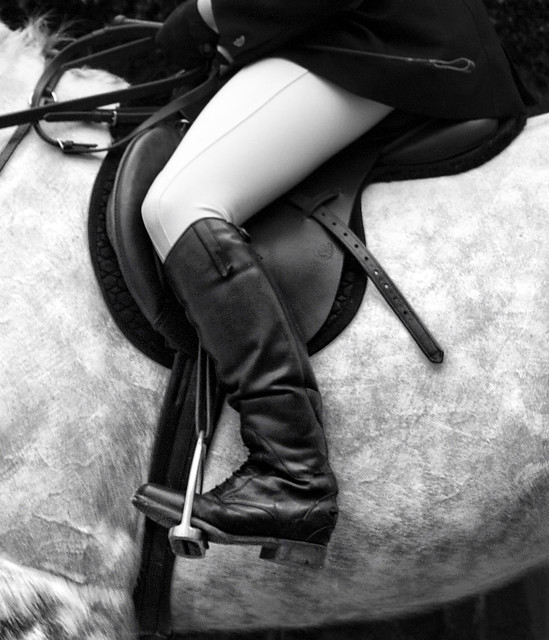
You may ask - what is the chair seat? Well, the name is sort of self-explanatory. In horse riding, a chair seat is when your leg slides too far forward and you sit too far backwards in the saddle, until you look like you're sitting on a chair instead of riding a horse. 
The chair seat disrupts the ear-shoulder-hip-heel line of balance that a rider should aim for by placing too much weight in the seat and not enough in the heels, which is why people with a chair seat also have the tendency for their heels to slip up. I know I definitely struggle with this problem, except in a different way from most - most chair seats will be accompanied with a tendency to lean too far backwards in the saddle, but for me it's the opposite. Too much jumping has caused me to "perch" and lean forwards, and I really struggle with tucking my hips underneath me and sitting deep. This "perching" position has thrown my centre of gravity forwards, making my leg slip forwards as well to compensate.

So, how do we fix the chair seat? 
I believe that the problem stems from not the leg, but the seat - if you sit correctly in the saddle, then your leg should find a more correct position by itself. If you're sitting correctly, you should be able to feel your seat bones on the horse, so experiment with shifting your seat forwards and backwards until you can feel your seat bones sort of "connect" with the horse's back. I'm still working on my seat, and I constantly have to remind myself to tuck my hips underneath me and lean backwards to create a more balanced position. I have found that by doing this, it is easier for my leg to stay underneath me and for my heels to stay down. 

If you don't think your problem stems from your seat, it may be that your knees are the problem - if you close your knees too much around the saddle, they create a block in your flow of balance and cause your lower leg to swing around. Think about opening your hips and your knees - this should help move your leg backwards so it is touching the horse's side. 

Sometimes, you just need to put your leg into the correct position and focus with all your might on making it stay there. Fixing your seat and leg position isn't a quick process - it takes a lot of hours in the saddle to change your muscle memory and adjust your position. It helps a lot if you can have someone watch you ride and tell you every time your lower leg moves forwards, as sometimes you can be unaware that you've slipped into a chair seat yet again. 

As I've stated, I'm still working on fixing my chair seat, so here are a lot of articles that have helped me a lot with my leg position and my position in general:

(DEFINITELY recommend reading this one!)
(the section on improving your leg position is quite helpful)

And some stretches to help you open your hips if (like me) your closed hips cause your knees to grip the saddle:

Hope this helps! Happy riding!

Rachel. 

Saturday, 27 February 2016

Storytime Saturday #4: Fear of a horse

A few months ago I was riding a horse called Splash, and while my first ride with him was amazing from there it took a bit of a plummet. See, Splash was a very forward and spooky horse but also quite strong, and in the wrong circumstances it was a bit of a disastrous combination. 
During my second ride on him, he bolted around everywhere and simply wouldn't listen to me. He ran through my hands, spooked at corners, and was completely out of control. My third ride was similar, with him consistently running off and spooking at a farrier working nearby. It gave me a really helpless feeling, and I suddenly became aware of how big horses were and how easily Splash could seriously injure me if he wanted to.
I want to make it clear that I actually love forward horses. I would choose a forward and spooky horse over a lazy/stubborn one any day. However something about Splash made him different from all the other forward horses I've ridden. Even though he wasn't particularly big, he was so unpredictable and I felt like he could do anything and I wouldn't be able to stop him. And after those horrible rides on him he became the first and to this day only horse that I was truly scared of riding.
This continued in a cycle for my next few rides with him - I would be scared as soon as I got on him, he would run through my hands and ignore my aids, and both of us had had a bad experience by the end of the ride.
But one lesson, after seeing how frightened I'd gotten, my instructor rode Splash before me to get rid of some of his energy. She took him out for a gallop and when I got on him, he was a completely different horse. He was quiet, respectful, and at times I actually had to urge him forward instead of constantly trying to pull him back. That ride really changed my perspective of Splash; the next time I rode him I was no longer frightened of him and from there things only got better. 

I don't ride Splash much anymore, but by the end we were working really nicely together and, above all, he taught me so much. What I realized was that me being scared of him was honestly the one thing holding me back, which sounds cheesy but is completely true. When I rode him, instead of thinking rationally about how to address his problems, I had a constant death-grip on the reins. Instead of giving him a chance to improve, from the second I got on him I was anticipating his bolt and spook, making me very tense and only furthering the issue.
It's easier said than done, but try going into every ride with a fresh mind. If you don't think about the time when you fell off your horse, or when you had a completely terrible ride on them, you'll find yourself having a much more constructive ride.  

Rachel.

Friday, 1 January 2016

Happy New Year!

Happy new year, everyone! I hope everyone had an amazing 2015, and I wish you all the best of luck for the year coming :)

For me 2015 was a bit of an interesting year, and quite difficult in terms of horse riding. I spoke about it a bit in Storytime Saturday: Frustration, but I'll reflect on it a little more here. When you start getting into the higher levels of horse riding, it's easy to become overly critical of your own riding and frustrated at all your mistakes and flaws. This is something that plagued a lot of my riding this year, especially as I felt that I wasn't making a lot of progress while everyone around me was advancing. At the beginning of the year, I had a new instructor who, in hindsight, was really quite awful. He was very critical of my riding and my position, but at the same time told me nothing on how I could fix it. I think that he was a reason my self-esteem took a bit of a plummet, and it didn't help that I wasn't able to get out to the stables as much because of school work.

However thankfully things took a change for the better as the year continued. At around May this year that instructor left, and was replaced by my current instructor who is honestly the best coach I've ever had (and I've been through a couple). She doesn't just tell me to do things - she tells me the precise reason why I should do things, explaining the functions of my aids in a whole new way to me. It is with her that I've become a more technical rider, and with the closing of this year I feel like I'm finally making progress again. Recently I've been having some amazing rides and I'm thankful that I'm able to end 2015 on a good note.

This year I went through a lot of obstacles, but I feel like it was a character development year. I've sorted through my problems and am on the road to improvement, and I have a feeling things are only going to get better from here.
So, I'll end this post by saying: 2016, come at me! 

Rachel.


Sunday, 6 September 2015

When to Change Barns

Changing barns can be tricky - take it from someone like me, who's switched barns three times since I started riding. Leaving behind your barn friends, instructors, and favorite horses can be incredibly difficult, however sometimes you just gotta do it. 
Thanks, Shia


The reason for this is that horse riding is an incredibly complex sport, and if your current barn doesn't a) have the right horses for you to progress on, b) the right instructors to help you along, or c) the best facilities for you, then it's probably time to move. 
Sometimes it can be about atmosphere - your barn has too much drama, is too competitive, isn't friendly enough, etc. However, in all of my cases, it's been about experience and what a barn can teach me. 
See, when you first start horse riding you'll probably be one of the worst riders at your barn with the least experience. You'll have people to look up to and people you can learn from, and you'll start climbing the ranks until you too become one of the experienced people. Life will be great, for a while. But then, what happens most of the time is you'll run into a bit of a wall. You'll have long periods of frustration where you just don't progress, where your lessons go over things you already know and you feel like you're learning nothing. Because while being one of the best riders at your barn can be great, it also means that eventually you'll hit the limit of what that barn can teach you and it's time to move on.
You may ask, what if I don't want to move? What if, even though I am not progressing as much as I could be, I am having loads of fun at my barn and don't want to leave? And I say, that's fine, but you have to make a decision about what type of rider you want to be. Do you want to be a hobby rider, who rides purely for fun, or do you want to be a more competitive rider, constantly improving and challenging yourself? If you want to be a hobby rider, then there's absolutely nothing wrong with that. Feel free to stay at whichever barn you're most comfortable at and have a blast! But if, like me, you fall into the second group of riders, then at some point you are probably going to have to move barns, and while it can be difficult, it is essential to becoming a better rider. It can be fun to be the most experienced rider in your lessons, but ultimately you will learn more from being worse than everyone else than you will from being better. 
Different barns also have different things to teach you, and in horse riding it's always good to have a wide variety of skills and methods. For example, my last barn was very jumping orientated but not very technical. My current barn is all about learning the nitty gritty bits of riding, and while that is better for me right now, the experience and practice I got from jumping at my old barn has been invaluable. 
So, if you are a competitive rider and think it's time to change barns, don't hesitate. Just do it!

Rachel.


Saturday, 5 September 2015

Trot to Canter Transitions- how to master them

For the longest time, I really struggled with my trot to canter transitions. While it is easy to get your horse to go from walk to trot, trot to canter is exponentially harder. It can be incredibly frustrating when you keep on kicking and kicking but your horse just won't canter, so in this post I'm going to try and help out all of you who have been having trouble.

First off, for a good trot to canter transition, you need a solid sitting trot. I've already done a post on the sitting trot, which I would advise you to read if you have trouble with it, but really the key to the sitting trot is relaxation and practice. It's not something that you can magically fix in 10 minutes - achieving a good sitting trot takes a lot of time, so be patient with yourself!
Secondly, this post will primarily be focusing on canter transitions when riding in a circle. So if you aren't riding in a circular shape, your aids and such will be slightly different to what I talk about, but hopefully I can give you a good sense of the basics.
Lastly, this post is going to get quite a bit more technical than previous posts, so sorry if it gets a bit confusing! I'll try my best to explain everything as well as I possibly can.

The first thing you need to understand is that going from trot to canter is not the same as going faster. If you've had trouble with your canter transitions, you'll know that the main problem is your horse just trots faster instead of going into canter. This isn't because your horse is being lazy/naughty, it's because your horse doesn't realize what you're asking of them. If you just kick and kick, your horse will think that you want them to trot faster, and while they may canter eventually, this isn't a correct transition and it's a lot more exhausting for you and the horse. This is why it's important to learn to ask your horse correctly, so your horse knows exactly what you want them to do instead of you giving them mixed signals. 
This leads me into what I believe to be the three most important things when asking for a transition - preparation, balance, and precision. I'll go into all of these in more detail soon, but first, let me tell you how I do my trot to canter transitions.

1. Make sure your horse has a nice, forward trot. This doesn't mean that your horse is trotting extremely fast with no control, it means that your horse has impulsion and is moving forward willingly. 
2. Go into your sitting trot so you can more effectively use your seat.
3. Give a half-halt (a small squeeze) on the outside rein (remember to keep the contact with both your reins). 
4. Move your outside leg back while keeping your inside leg near the girth.
5. Squeeze/kick with your legs depending on how sensitive your horse is. Ideally, your horse should canter almost immediately. 

Now, let's talk about why I do all of those steps by going through the three things I said before - preparation, balance, and precision.

Preparation: It's really important to give yourself and your horse a good preparation to make things as easy for the both of you as possible. Think of it - if your horse is being lazy, isn't listening to you, and you're having a really hard time keeping them in the trot, are you going to be able to get them to canter? Probably not. Even if you do steps 2-5 perfectly, if your horse isn't listening to you, you aren't going to get a good transition. This is why preparation and step 1 are so important. When you are warming up before you canter, really spend time making sure that your horse is being attentive and has enough impulsion that you feel like you could easily ask for them to canter.
Preparation is also really important for the rider themselves so they can adequately perform steps 2-5. Before you try a canter transition, make sure you're balanced and organized and your life will be so much easier.

Balance: Balance is always important in horse riding, but it is especially important when changing from one gait to another. Trot to canter transitions are quite hard work for a horse, and if they're asked to do one while they're unbalanced it's quite difficult for them - it's like standing on a balance beam and being told to do a handstand when you're about to fall off. 
Let's talk about riding in a circle for a second. Ideally, your horse will have a bit of an inside bend, like this:
However, this can also cause your horse to lean in its inside shoulder, thus making them unbalanced. Enter step 3: your reins can be used to balance your horse in more ways then one. So, give your outside rein a squeeze to put their weight back onto their outside shoulder. This also tells your horse that something is coming up and to pay attention, and makes sure your horse picks up the right canter lead because it blocks the outside shoulder from moving forward. Then, make sure you keep the contact in both reins during your transition - if you give your horse lots of rein, they're just going to go faster and become strung out, which we don't want. Instead, keep a steady contact so your horse can stay steady and balanced and have a (hopefully) immediate transition.

Precision: Remember how I said to make sure your horse knows what you're asking of them? This is where precision comes into play. Step 4 is all about making the horse understand that you want to do a canter transition, not do a faster trot. Instead of you just kicking with both legs in the normal position, the sliding back of the outside leg differentiates you asking for a canter transition from you asking to go faster. Then, give a clear squeeze/kick with your legs, and hopefully your trot to canter transition will happen without fault.
However, if you do these steps half heartedly, your horse isn't going to get the memo. Be precise with everything you do, making sure that all of your aids are clear enough and aren't messy and giving your horse mixed messages. This step can be a bit difficult if you, the rider, are not used to doing trot to canter transitions, but things will come with time and practice, so try not to get too frustrated with yourself if you can't get it the first time!

Those are all my tips and tricks for how to get a good trot to canter transition :) I hope that I helped you out in some way and I wasn't too confusing. Remember, everyone has different things that work for them, so you don't need to follow my steps exactly - feel free to tweak a few!


Rachel.

Wednesday, 10 June 2015

Storytime Saturday #3: Frustration

Hey guys,
So, today I wanted to talk about something that I had been struggling a lot with recently and have only just gotten over. I love horses (obviously) and before recently there had never really been a time when I hadn't wanted to go to the barn. I was always itching to go, and horse riding was the highlight of my day.
But recently, that sort of changed. I ran into a bit of a wall with horse riding, and I wasn't really making that much progress. When I rode, I never really achieved the things that I wanted to achieve and I came back from rides feeling sort of down for that reason. I suddenly wasn't really looking forward to it anymore. Horse riding turned into a lot more work and a lot less fun.
Not to say that I didn't still love horses - I did, and I still do. It's just, riding wasn't the highlight of my day anymore, and I didn't know how to change that. I felt really frustrated, because horses were practically my life. They were who I am. If I didn't love horse riding anymore, where would that leave me?
I thought a few things over. Maybe I should take a break? Maybe I should just go on a few relaxing trail rides? Maybe I had just outgrown horse riding, and it wasn't for me anymore.
But, just the other week, I had a really fantastic ride. Everything in that ride seemed to go right, and suddenly I was back in the game. It was as simple as that. Having a good ride made me remember why I loved horses so much.
And, in hindsight, I know that I didn't really fall out of love with horse riding. It was just a combination of
a) continually riding difficult horses. While they helped improve me as a rider, they also made my rides really exhausting and I could never really focus on myself and achieving my own personal goals
b) constantly switching to new instructors because my old one left and they are still finding a replacement.
and c) criticizing myself too much and focusing too much on the things I was doing wrong instead of the things I was doing right.

I guess what I'm trying to say with this mildly cheesy rant is that horse riding is an extremely complex sport where it is very easy to frustrate yourself because you aren't doing little things correctly. You don't have enough control, your heels won't stay down in your transitions, your leg isn't secure enough, your hands are not soft enough, your horse refuses to accept the bit - these are all problems that I've had in the past and sometimes, they are very hard to overcome, and this can make you extremely frustrated. However, it's also really important to just relax every once in a while, to have a good ride and just have fun. Because horse riding is a fun sport, and that was something that I was forgetting.

Rachel.

Sunday, 8 March 2015

The importance of flat work and common jumping errors

I love to jump. Jumping has got to be my favorite thing to do on horseback. And sometimes, when compared to jumping, flat work can seem kind of...boring. However, all of the foundations of riding are developed on the flat, so it is very important to do consistent flat work training to work on your riding errors instead of just jumping all the time.
A common phrase in the equestrian world is that jumping is flat work with speed-bumps. And it's true- without a solid position on the flat you will never produce the results you would like when jumping a course. Jumping is fun, yes, but when you jump all of your position errors are emphasized, and those errors can be very dangerous to both you and your horse.
Common example: many riders think that if they can walk, trot and canter semi-functionally, then they are ready to jump. However, being able to walk, trot and canter isn't enough. The rider must be BALANCED, with a strong position and a steady flow of weight into their legs. Remember my two point position post? If not, have a read through it. The position that I talk about, the ideal two point position, can only be obtained by a balanced rider with a solid foundation on the flat. Without a solid two point position, your jumping is seriously compromised, and the way to gain that position is going back to flat work.
Common errors in rider's jumping positions:

  • The swinging leg: if, when you go over a jump, your leg swings backwards, go back to the flat. Chances are, when you canter on the flat, your leg swings as well. You may also be bracing against the stirrup when you jump, causing your leg to go backwards. All of these things mean that you have a weak leg. If you continue jumping with a weak, swinging leg, you could really hurt yourself or your horse, especially when the jumps get bigger. To fix this problem and strengthen your leg, do lots of no stirrup work. Do lots of two point on the flat as well, really making your weight flow down into your heels.
  • Hanging onto the mouth: some inexperienced riders tend to pull on their horses mouth as they go over the jump, bracing on the horses mouth to balance. What this means is that they are an unbalanced rider. They cannot balance themselves through their seat and their legs, so instead they hang onto their horses mouth to stay on the horse. To fix this problem, go back to the flat. Do lots of flat work until you have an independent seat and you don't need to use your horse to balance. You can also take lunge lessons with no reins, which will really teach you to balance with just your seat.
  • The big bang: if you suffer from "the big bang" (fantastic name, I know) it means that you'll go into two point just fine when your horse goes over the jump, but when he lands, you'll land heavily on his back with a big bang. It's unpleasant for both you and your horse, and it means that all your weight is in your seat instead of in your heels. To fix this problem, go back to the flat (are you noticing a common theme here?). Really work on getting your weight into your feet and getting your heels down. A good exercise for this is to do two point on the flat.
Basically, what I'm trying to say with all this is that flat work is important. Don't dismiss flat work once you start jumping and just jump every time you get on your horse. Save some time for flat work too- yes, it doesn't give the same thrill as jumping, but it is important nonetheless. If you don't have clean transitions, a good position, clear, effective aids and impulsion on the flat, then when you jump you really won't get the same results as a rider that does. Take some dressage lessons, work on your position, and then go back to jumping and you will be surprised at how much better you feel.
Thanks for dealing with my semi-rant, and sorry for not posting, like, at all. I've been really busy with school and riding and just life in general, so while I might not post as much, I promise I'll come back every once in a while to make a little post :)

Rachel.

Sunday, 21 September 2014

Ways to learn about horses, without actually being around horses

Admittedly, the best way to learn about horses and improve you riding it to actually be around horses, whether you are on the horse or just at the stables. But not everyone has the time or the money to be at the stables 24/7. So what other ways are there to actually learn about horses? 
Reading Books:
That's right- it's time to crack some spines! (book spines. please don't crack someone else's spine) There are so many non-fiction books about horses and so much that these books can teach you. If you go to your local library, chances are there will be at least one horse book there that can help you. In the past, I have recommended Storey's Horse-lover's Encyclopedia, but I will also recommend the Complete Horse Care Manual if you are more of a beginner to horse care
The Complete Horse Care Manual, pic from indoexpatriate.wordpress.com

However, there are many more that you can check out, from books about exercises on horse back, to training manuals, to books about horsemanship. 

But it's not just the non-fiction books that can help you. You can learn plenty just by reading about horsey adventures in fiction books! I used to be (and still am) a massive fan of the Phantom Stallion series, as well as anything by Stacy Gregg and the A Circuit series.

Watching Videos:
Whether they are DVDs or youtube tutorials, there is plenty to learn from watching videos. Even by scrolling through the youtube comments in a horse video you can find lots of advice, though some of this is not the best. A channel I will highly recommend is Evention, which is run by two eventers who have lots of experience to share. Just watching horse riding on tv can be helpful, by listening to the commentary or watching the experts do their thing.

Evention's logo, pic from www.schrammequestrian.com
Looking Online:
Wanting to know the answer to a particular question? Search it online, and I guarantee you will find the answer. Want some tips to improve your riding? Just look it up, and you'll probably find something to help you. Even if you just want to read up more on horses, type the word horse into the search bar and read to your heart's content. There are so many resources on the internet, and it can be even more helpful than reading books, just because it is quick and easy. If you're on this blog right now, chances are you've done some reading already ;)
and last but not least

Join a Horse Forum:
There are many horse forums on the internet, but the biggest ones are HGS forum and horseforum.com. If you can't find the answer you want by searching the internet, ask the question on a horse forum. You don't even have to post in a forum to benefit from it- I have learned so much just by browsing the different threads and conversations. There are a lot of experienced horse people on online forums, and they have heaps of information to share.

I hope that this has been helpful and that you learn heaps :)

Rachel.


Tuesday, 29 July 2014

Heels Down!

A thing that all horse riders hear their instructors yell at least once is "HEELS DOWN!!" Having your heels down and toes up is seen as quite important in the horse riding world. However, there are some flaws in the saying, which I'll be explaining further down in the post.

First off: why should you keep your heels down?
When you are on a horse, it is important to keep some of your weight in your stirrups. This is because if all your weight is in your seat, if your horse spokes or moves suddenly it is easy to slip right off and hit the ground. However, if your weight is in your feet, it is easier to move with the horse and follow its movements, thus staying on. When you have a good flow of weight down your legs into your feet, it anchors you to the saddle and creates a more secure position. However, because of your stirrups are on the balls of your feet, your toes can't move down with the weight. This is why your heels go down- because your weight is lowering it.

Picture from flickr.com
But there are some things wrong with this.
It is not the concept in itself that is wrong, but the way that people are taught it. "Heels down heels down heels down heels down heels down" is often drilled into people's minds as soon as they start riding, and this causes people to just shove their heels down instead of actually letting their weight lower their heels. This can cause a few problems, namely that by doing this you don't actually have a correct flow of weight. 
Another problem people have is that when they are constantly told to put their heels down, they actually put their heels so far down that it gives them an incorrect leg position. when your heel is too low, your leg tends to come forward, which can result in a chair seat. You should be able to draw a vertical line from your hips to your heels.

What to do if you're having trouble keeping your heels down.
There are several things that could be stopping you from getting your heels down.
1. You just can't get your weight to sink down into your heels.
This was a problem for me, and it took few years for me to finally get my heels down and a steady seat, so if you're also having trouble getting it, don't be discouraged. Unfortunately these problems can't be fixed overnight, and it takes patience and time in the saddle to perfect them. 
Something you can try is when you get on a horse, stand up in your stirrups and let all your weight just go down into your feet. You should feel your heels go down on their own accord. This puts your leg in the correct position. Sit back down and try and keep that position and feeling when you ride.
A common problem that people have that keeps them from putting their heels down is knee gripping. Knee gripping is never a good idea as it creates a pressure point and disrupts the weight flowing to your heels. If you're tensing any part of your leg, that could also disrupt the weight flow. If this is your problem, try and keep your legs and the rest of your body relaxed and supple to allow your weight to flow into your heels.

 2. Your heels physically can't go down because of inflexible ankle muscles
Some people have naturally inflexible heels, making it hard and even painful for their heels to go down. For your weight to flow into your heels, it is essential to have a nice, relaxed and supple ankle. To achieve this, there are a few exercises that you can do.
  • The stair exercise: This is a well known exercise where you stand with your toes on the edge of a staircase and let your heels drop. You can also touch your toes while in this position to further advance the stretch. Hold for longer and longer time periods until you can drop your heels without feeling any pain.
    Staircase exercise, pic from webmd.com
  • Lunge: keeping your two feet parallel, bring your right leg forward and bend your knee. Make sure your left leg is straight and your heel is touching the floor. You should feel a stretch in your left Achilles tendon. If you can't feel the stretch, put your feet further apart. 
An important thing to remember is that it doesn't matter if your heels aren't noticeably down, as long as your weight is in them. So if your problem is inflexible ankles, don't stress yourself too much if you still have a steady leg and you're not losing your stirrups.
Picture from wall.alphacoders.com
Well that's all I have to say :) I hope you learned something from this post and are able to better understand one of the most well-known sayings in the horsey world.

Rachel.

Saturday, 4 January 2014

Storytime Saturday #2

Well, since my blog suffered severe abandonment, I've only done one Storytime Saturday, when I originally planned to do them almost every week.
But I'm finally back and posting, so I'm doing my second one today, and my story is on horse leasing.
You see, when I was younger and not nearly as experienced, I was offered a horse lease by a person that was going away to queensland for 6 months. At the time, it was very exciting. Like SUPER DUPER exciting, since I was still really upset about not owning a horse, and I thought that leasing was the next best thing. 
So, I went and tried out the horse. I really loved her, because I loved to go fast, and this pony was about as fast and sensitive as they got. The deal almost worked out. I was so excited. I thought about all the fun I was going to have, about all the things I was going to learn, blablabla.
But what I didn't realize at the time was that that deal really wasn't good for me... at all. I could list the endless reasons why the deal wasn't good for me. The venue had very limited facilities, there wasn't going to be anyone supervising me, but mostly because I wasn't experienced enough, and I thought I could control the horse when really, I couldn't. 
When the deal didn't work out (and thank god it didn't otherwise I would probably have a million injuries and made half the progress I have now), I was devastated. I kept thinking about what a great deal it was (which it wasn't) and how much I loved the horse. I think it took me a while to realize how bad the deal had been for me, because I was so focused on the fact that I was FINALLY going to be leasing a horse and less focused on how I was actually going to make progress. Actually, no, that's a bit of a lie. I was thinking about how I was going to make progress, except at that point in my life, I thought the only way to make progress was to lease. I thought that I knew so much about horse riding, that leasing/buying a horse was the only thing that could benefit me.

I have this theory that the more you know, the more you realize you don't know. And it's true, for me at least. After the lease didn't work out, I moved to a different barn and started learning things I had never even thought about before. I started realizing how much I didn't know, and how I really wasn't very experienced at all.
Looking back now, I'm not upset that the deal didn't work for me, not one bit. Because I know that if the deal had worked out, I wouldn't have realized my flaws, and I wouldn't have realized how I could improve. Really, I wouldn't be half the rider I am now. Thinking small and taking good lessons has taken me so much further than thinking big would have.
So anyway, the moral of this story is to not jump ahead into things when you're not ready- Having/leasing a horse is not the only way to move forward. Start small, take lessons, and realize how much you DON'T know before making any big decisions. 

Rachel.

Book Recommendation - Storey's Horse-Lover's Encyclopedia


Storey's Horse-Lover's Encyclopedia is a really great horse book that I highly recommend. It contains information about every possible word related to horses (well that might be a slight exaggeration). It is illustrated and everything is explained very clearly.
It's a really fantastic book because if you're unsure on a word, you can simply just look it up in this book. It has really helped increase my horse vocabulary and knowledge over the years, so if you are new to horses, this is the book for you!

Rachel

Riding Bareback

Riding bareback is when a horse is ridden without a saddle. But it's not as simple as just getting on a horses back and riding them into the sunset without tack. Riding bareback can be difficult, mainly because it is so much easier to fall off. A horse's back is very slippery and if you're not careful you could slide right off!
Picture credit to http://www.freeonlineblogspot.com

Choose your horse carefully:
Some horses aren't really suitable for bareback, especially when you're just beginning. It is preferable for your horse to fit the following requirements:
  • A reliable horse: When you ride bareback, you should start off riding horses you know you can trust. Also try using a horse you know has been ridden bareback before, as some horses don't like being ridden bareback and may act up, which is the last thing you want!
  • A horse that isn't overly sensitive: It is best to start with a horse that isn't overly sensitive as you are much closer to the horse while riding bareback without the saddle to separate you. This way, even the slightest squeeze may be enough to get a sensitive horse going, even if you didn't mean to do it, and being caught offguard when a horse suddenly speeds up is a good way to fall off.
  • Preferably a horse that isn't too bony: While this isn't a necessity, bony horses are very uncomfortable to ride bareback on. Most people prefer riding horses that are a bit chubby. It also helps if the horse doesn't have a bouncy trot, as when you ride bareback you have to sit trot.
Your Position:
Your position when riding bareback is really important, as it could be the difference between staying on and falling off! 
When you ride without a saddle, it is very easy to be left behind by the horse's movements. For this reason, it's important that you sit more forward than you normally would, right behind the horse's withers.
Starting off, it also helps to grab a bit of mane to keep you forward and balanced, and to make sure you don't pull on your horse's mouth. Getting lunged your first time is also a good idea, so you can focus less on steering your horse and more on your seat.
picture credit to http://www.ponytalesblog.com

 Some things to be careful of:
Even though some of you might want to start riding bareback right away, there are a few things you need to be aware of:
  •  Like I said at the beginning, riding bareback is more dangerous than riding with tack because it is so much easier to fall off.
  • You are not going to be able to start cantering right away. First you need to make sure you are comfortable and balanced riding at both the walk and trot, and this takes longer than you'd think.
  • While riding bareback is a great way to develop your seat, it is also essential that you have a good seat to begin with. You need to be able to sit the walk, trot, and canter with confidence without balancing on your horse's mouth. Otherwise, when you ride bareback you'll just bounce around and pull on your horse.
  • Because you are so close to your horse when riding bareback, it is also easier for your horse to get sore and uncomfortable. This is another reason you should have a decent seat before you start riding bareback.
Why should you ride bareback?
While what I just said was a bit grim, there are plenty of reasons why you should ride bareback when you're ready.
  • Improve and develop your seat: Riding bareback helps you grow independent from the saddle, meaning that you stop relying so much on the saddle to stay on. You also develop a deeper seat, and you'll find yourself bouncing less and sitting more, if that makes sense.
  • It's quick: If you're lacking time, not putting on the saddle can save you some time and help you squeeze in some extra minutes of riding.
  • It builds trust: Riding bareback is a great way to build trust between you and your horse, and make you feel closer than ever. A big reason people love riding bareback is because it makes them feel one with their horse, without anything between them.
  • It's fun!: Riding bareback is an extra challenge, and, when you get used to it, is a really fun way to ride!

Picture credit to http://traceyspicsandpastels.com
Ride safe, and have fun!

Rachel.

PS: So sorry for not posting in ages! I'll try to make it up to you guys, but in the meantime, happy late new years and merry even later Christmas! I hope you all had a fantastic time.

PPS: I just realized how many dot points this post has. Oops

Monday, 1 July 2013

The basics on leading horses

Hey guys! I'm posting twice today so if you haven't already make sure you look below for my first Storytime Saturday post!
Today will be a relatively short post on how to lead horses. This is pretty easy stuff so some of you will probably already know the information here. But if you don't know how, this post will explain everything you need to know!
When around horses, you aren't going to ride them everywhere. You're going to have to lead them from the ground a lot as well. So I put together a list of things you should do when leading a horse.

This picture shows a horse being led correctly with a lead rope. Pic from http://www.carolynresnickblog.com

  • Stand on the left side of the horse (as shown above in the picture). Originally this was so your right hand was closer to the horse to give you more control, but now everyone leads from this side, even left handed people.
  • Don't look at your horse when you lead them. Instead, look where you are going. If you look at your horse it makes them nervous and reluctant to move.
  • Lead the horse with your right hand close to the horse's chin, but not too close. Make sure you give your horse some slack in the rope so they are comfortable. Hold further down the lead rope with your left hand to make sure it doesn't drag on the ground.
  • Now walk! Your horse should follow you without too much trouble but if they are being stubborn give a small tug with the lead rope to get them to move. Make sure you stay beside the horse and don't walk too much in front of them otherwise they might step on your heels.

A horse being led correctly with reins. Pic from http://ajilbab.com

  •  When leading a horse with a bridle and reins, you lead the same way as you do with a lead rope, except you hold the two reins together in one hand (as shown in the picture above).
I hope you learned something from this post. See you next time! 

Rachel.

Storytime Saturday #1

So incase you missed it I am starting something new called Storytime Saturday. Technically it's monday today where I am, but whatever I have a story so I'm sharing it anyway :)
Today I was horse riding and after my ride Minty (the horse I was riding) was really sweaty and dirty. He's a grey, so dirt shows really easily, and it was too cold to give him a bath.
So I groomed him for a long time using my new brushes that I got last month. I got most of the dirt out, and  I spent a while getting rid of a lot of the sweat and making his hair all smooth. I stood there for at least half an hour, trying to get him relatively clean. And then when I was finally satisfied, I gave him some carrots and released him into his paddock.
And do you know what he did? As soon as I walked out of the paddock and shut the gate he started rolling.
I know that horses roll for a bunch of different reasons, but when minty rolled, it looked like he was doing it not because he was in pain, not to scratch his back, but for fun.
I groomed him for over half an hour and then he just had to roll and cover himself in dirt again, making all my hard work go down the drain. Thanks Minty.


Anyway its holidays now so I should be posting more often so watch out for more soon :D

Rachel.


Sunday, 16 June 2013

How horses are measured.

If you read one of my first posts, I mentioned that horses are measured not in cm, not in inches, but in hands. But how big is a hand? A hand is not the length of your own hand- a hand is 4 inches, or approx. ten centimetres. 
A horse is measured from the ground up to its withers, which is the tallest point of a horse's back. They are not measured to their head, like humans, because their head is constantly moving up and down, so if they were measured from their head their height would always be changing.
The circled area is the horse's withers
So if you look at this picture:

Then the green line is the length that is measured to see how tall the horse is.
So let's say that you have a horse that is measured to be 15hh (hands high). That means that the space from the ground to the horse's withers is 60inches long, or 150cm.
If the horse is 16.2hh, then it means that it is 16hands and 2 inches tall, or 66inches tall. This means that if a horse is 65 inches tall, they would be 16.1hh, or if they were 66 inches tall, they would be 16.3hh. When horses are 68 inches tall (or any other number divisible by four), then they go on to a new hand, so they would be 17hh. That's why there is no such thing as a 16.5hh horse. They would be called a 17.1hh horse instead.
A horse that is less than 14.2hh is classified as a pony. If they are taller than 14.2hh then they are classified as a horse.

To find out the exact height of your horse, you can use a tape measure, or if you are experienced you can usually make rough estimations on the horse's height by looking at them.

How horses are measured can be a bit confusing at first, so hopefully this post made sense! 

Rachel.